
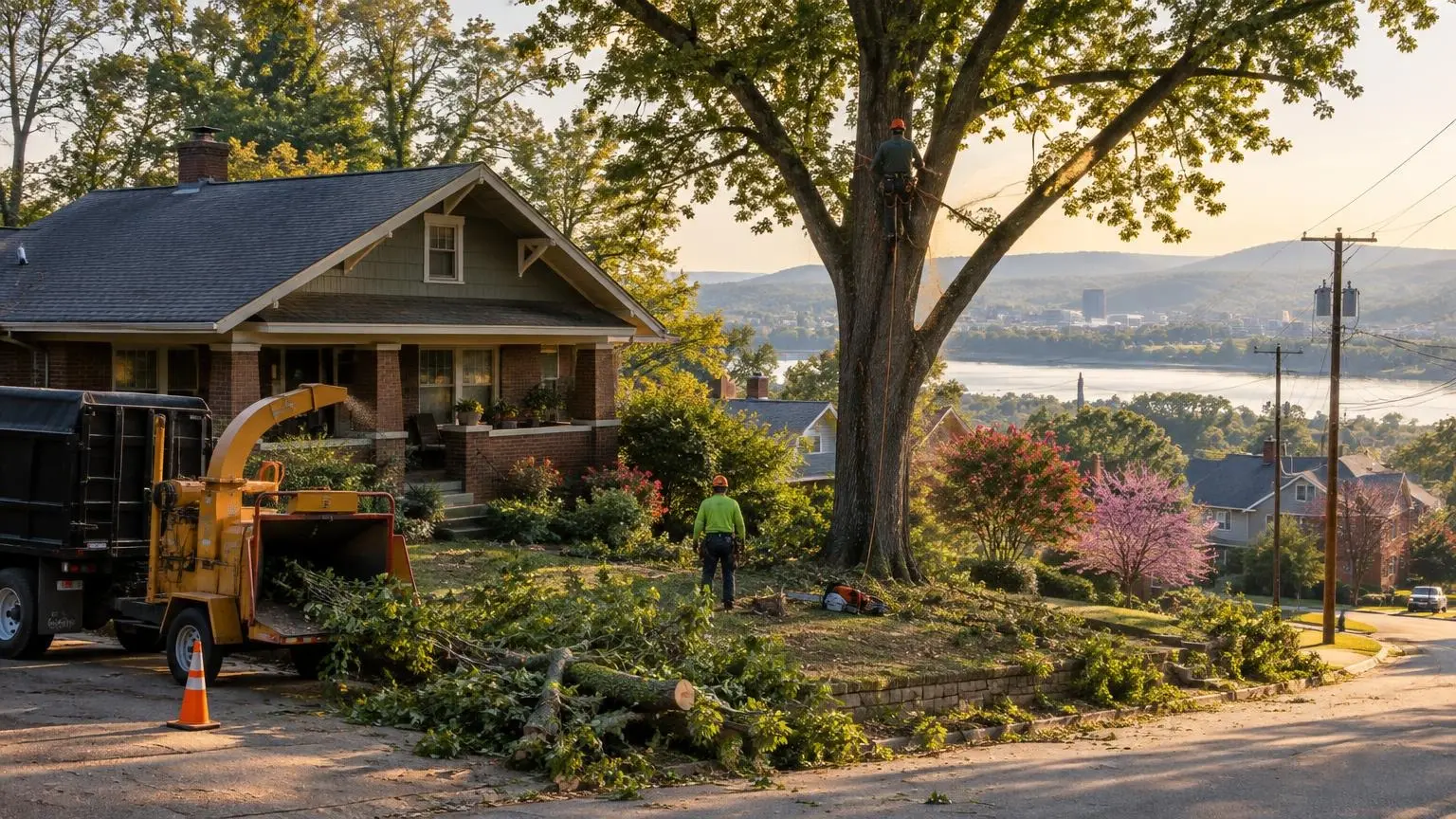
On the southwest edge of Lake Conway
Tree Service in Mayflower, AR
Lakeside trees, second-growth woods and the long shadow of the 2014 tornado.
- Free on-site estimates across Little Rock and central Arkansas
- A clear written price, no lump-sum guessing
- Yard left raked and cleared as agreed
Lakeside Trees in a Small Town
Tree Service in Mayflower usually involves water, woods or both. The town sits on the southwestern edge of Lake Conway, about 10 miles south of Conway and 20 miles northwest of Little Rock, and covers only about four square miles. The land here was heavily wooded and was logged extensively until around the turn of the 20th century, so much of the forest standing today is second growth on old farm and timber ground.
Trees on the lakeshore
Shoreline trees live with wet feet. Their roots spread wide and shallow in saturated soil, and they tend to lean out over the water toward the light. That combination makes them more likely to tip after long rains or high wind, and when they fall they can take a dock, boathouse or seawall with them. On lake lots we look at: 1. Lean toward the water and whether it has changed 2. Bank erosion exposing roots 3. Deadwood over docks, decks and walkways 4. Whether removal would destabilize the bank, in which case a reduction or leaving the stump and roots in place may be better
On steep banks, we often cut the tree but leave the stump to keep holding soil.
April 27, 2014
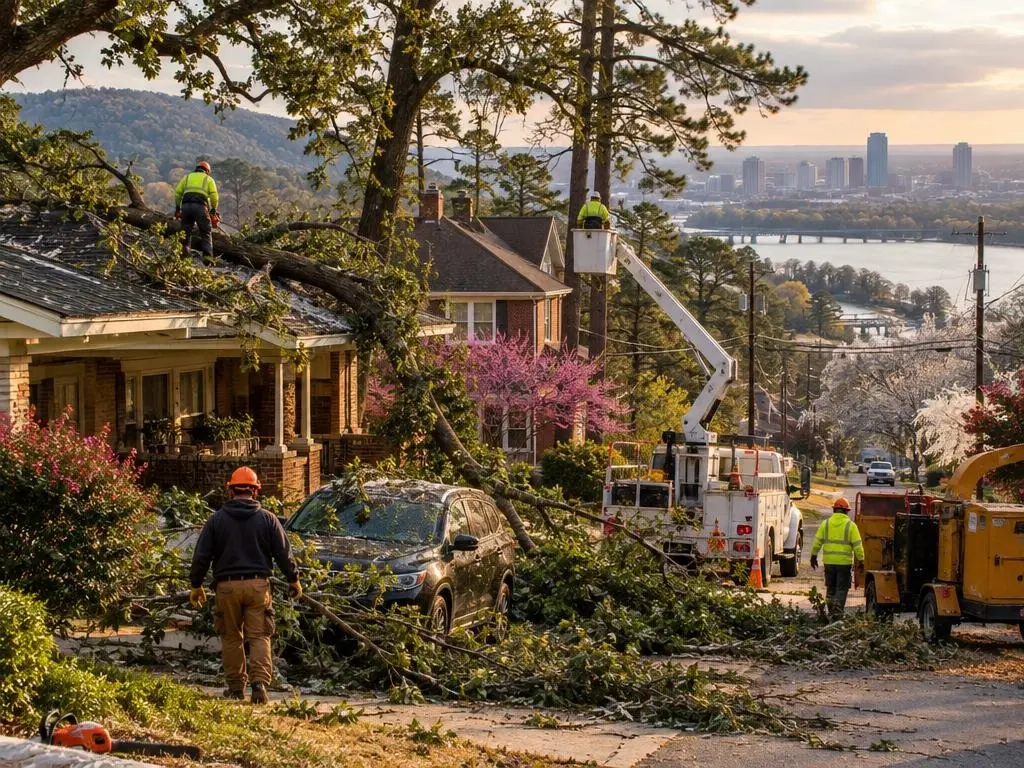
Just before 8 p.m. on April 27, 2014, an EF4 tornado struck Mayflower on its way to Vilonia. The National Weather Service mapped a 41-mile path from northwest of the Little Rock area to near El Paso in White County. Sixteen people died, 12 of them in Faulkner County, and an estimated 400 to 500 homes were destroyed. Trees that survived that night often carry hidden damage: twisted trunks, cracked unions and broken tops that resprouted. Years later, some of those trees are still worth checking before they fail.
Second-growth woods behind the house
Many Mayflower homes back onto woods that regrew after logging and farming. Second-growth stands are often crowded, with tall, thin trees that leaned on their neighbors for support. When a lot is cleared next to them, or storms knock out part of the stand, the remaining trees are suddenly exposed. Thinning out the weakest and most dangerous ones near the house is often the right first step.
Willows, cypress and other wet-ground trees
Trees growing at the water's edge are often species that tolerate wet soil, such as willows, river birch and bald cypress, along with oaks and sweetgums a little higher up the bank. Willows grow fast and break easily, and their limbs fall onto docks and boats. Cypress are sturdier but can grow very large. Each needs a different approach, and we explain the options during the visit.
Access from the street
Most lakefront lots in Mayflower are reached from the street side, with the house between the road and the water. That means wood from a shoreline tree has to travel uphill past the house. We plan the route ahead of time, protecting lawns and landscaping with mats where needed.
Getting an estimate
Call (501) 457-9035 or use the form. Mention whether the trees are near the water, and whether access is by land or easier from the lake side. We will come out and put the plan in writing. Get a free estimate
Mayflower Facts
- On Lake Conway. Mayflower sits on the southwestern edge of Lake Conway, the largest man-made lake managed by the Arkansas Game and Fish Commission, and is known for fishing.
- Logged woods. The land around Mayflower was heavily wooded and was logged extensively until the turn of the 20th century, leaving largely second-growth forest today.
- 2014 EF4 tornado. The April 27, 2014 EF4 tornado struck Mayflower before reaching Vilonia; its 41-mile path killed 16 people and destroyed an estimated 400 to 500 homes.
- Small town. Mayflower incorporated on March 6, 1928, covers about 4.05 square miles and had 1,984 residents in 2020.
Mayflower Questions
Should I remove a tree leaning over the lake?
Not always. If it is healthy and not threatening a dock or structure, a reduction may be enough. If it is leaning more each year or the bank is eroding under it, removal is usually safer, sometimes leaving the stump to hold the bank.
My trees survived the 2014 tornado. Could they still be damaged?
Yes. Wind can twist and crack trunks and limbs without bringing the tree down. Decay can then move in slowly. A close inspection of the main unions and trunk is worth it for big trees near the house.
Can you get equipment to a lakefront lot?
Usually from the street side. On tight lots, we may rig pieces down and carry them out. Let us know about steep slopes or narrow side yards when you call.
Do you clear brush and small trees along the shore?
Yes, though we keep enough vegetation to protect the bank from erosion.
Free Estimates in Mayflower, AR
Free estimates for Mayflower homes on and near Lake Conway.
Tree Service Near Mayflower
- Tree Service in Little Rock, AR
- Tree Service in Pulaski Heights, AR
- Tree Service in Cammack Village, AR
- Tree Service in North Little Rock, AR
- Tree Service in Sherwood, AR
- Tree Service in Jacksonville, AR
- Tree Service in Maumelle, AR
- Tree Service in Roland, AR
- Tree Service in Scott, AR
- Tree Service in Cabot, AR
- Tree Service in Austin, AR
- Tree Service in Ward, AR
- Tree Service in Lonoke, AR
- Tree Service in Benton, AR
- Tree Service in Bryant, AR
- Tree Service in Alexander, AR
- Tree Service in Shannon Hills, AR
- Tree Service in Bauxite, AR
- Tree Service in Conway, AR
- Tree Service in Vilonia, AR